
From Covenant Monitoring to Regulatory Reporting
What Our Customers Helped Us See
Craig Davis
Co-Founder
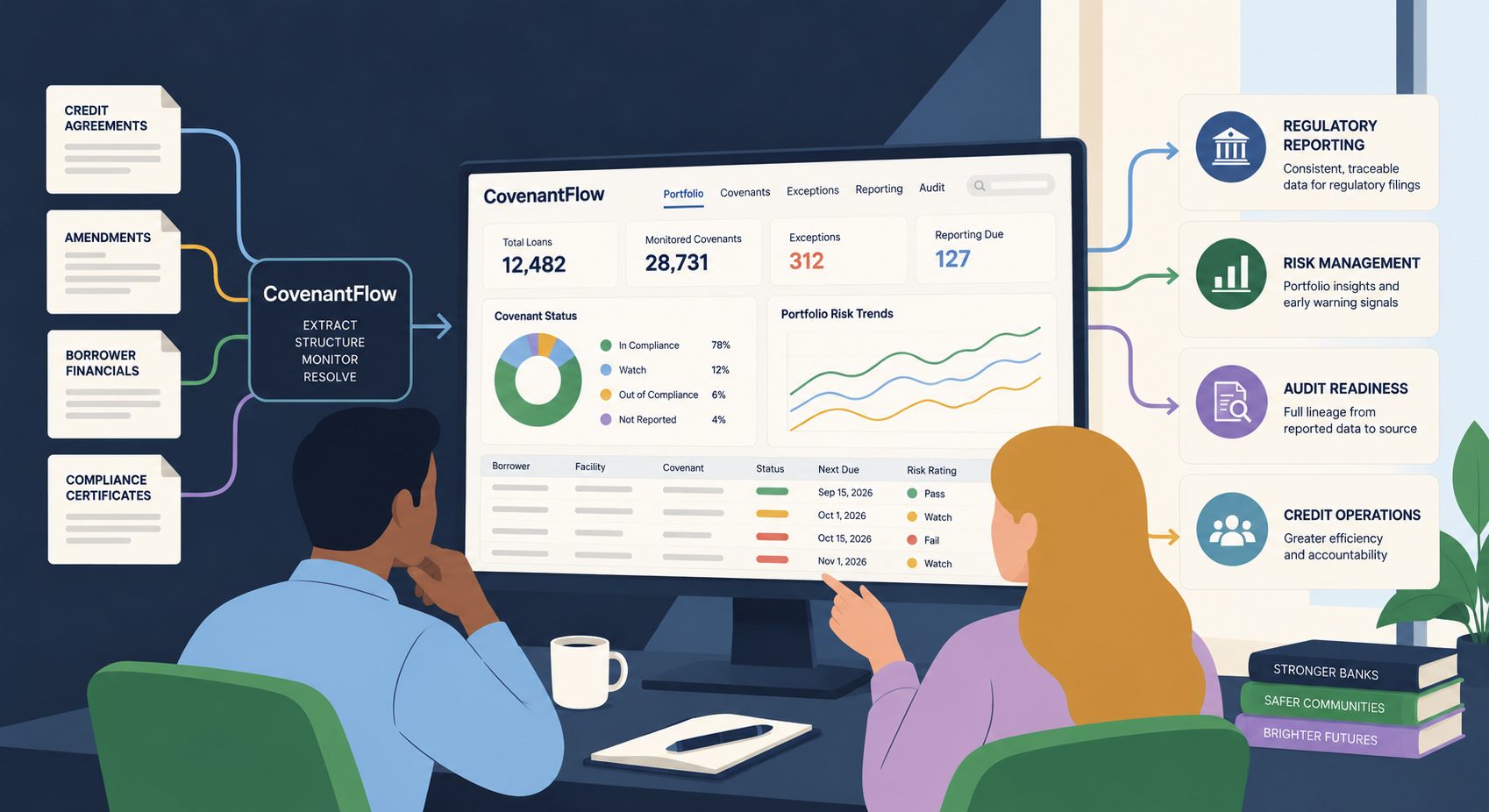
When my cofounder John Sotoodeh and I started building CovenantFlow, we were focused on a fairly specific problem. Banks have thousands, and in some cases tens of thousands, of commercial loans with covenants, reporting requirements, deadlines, amendments, waivers and other obligations that need to be monitored over the life of the relationship. A surprising amount of that work is still manual, with important information spread across loan documents, spreadsheets, inboxes and different banking systems.
We believed AI could fundamentally change that. Our original vision for CovenantFlow was to give banks a way to extract important terms from loan documents, turn those terms into structured data, monitor compliance across large portfolios, identify issues and help teams manage those issues through resolution.
As we started building the platform and spending more time with banks, our customers kept reminding us of another benefit. The structured data we were creating for covenant monitoring could also solve some difficult problems for Risk, Audit and Regulatory Reporting.
John saw the connection quickly. Before we started CovenantFlow, he spent much of his career in banking, including senior operating roles at Banc of California and Wells Fargo. His perspective was that identifying a covenant issue is only one part of the problem. A bank also needs to be able to explain what happened, what information it relied on, what the credit agreement required at that point in time, how a determination was made, who reviewed it, and how the issue was ultimately resolved.
It turns out that many of those questions line up closely with what regulators expect banks to be able to manage. Federal Reserve guidance on credit risk review specifically identifies borrower performance, credit and collateral documentation, proper approvals, adherence to loan agreement covenants, risk ratings and compliance with internal policies among the areas evaluated in a credit review. The OCC’s updated 2026 handbook similarly emphasizes risk management throughout the life of a loan and the ability to identify changes, trends, concerns and emerging risks across a portfolio.
Those conversations changed the way we thought about what we were building, and we began developing solutions specifically around those broader needs.
Turning Loan Documents Into Usable Credit Data
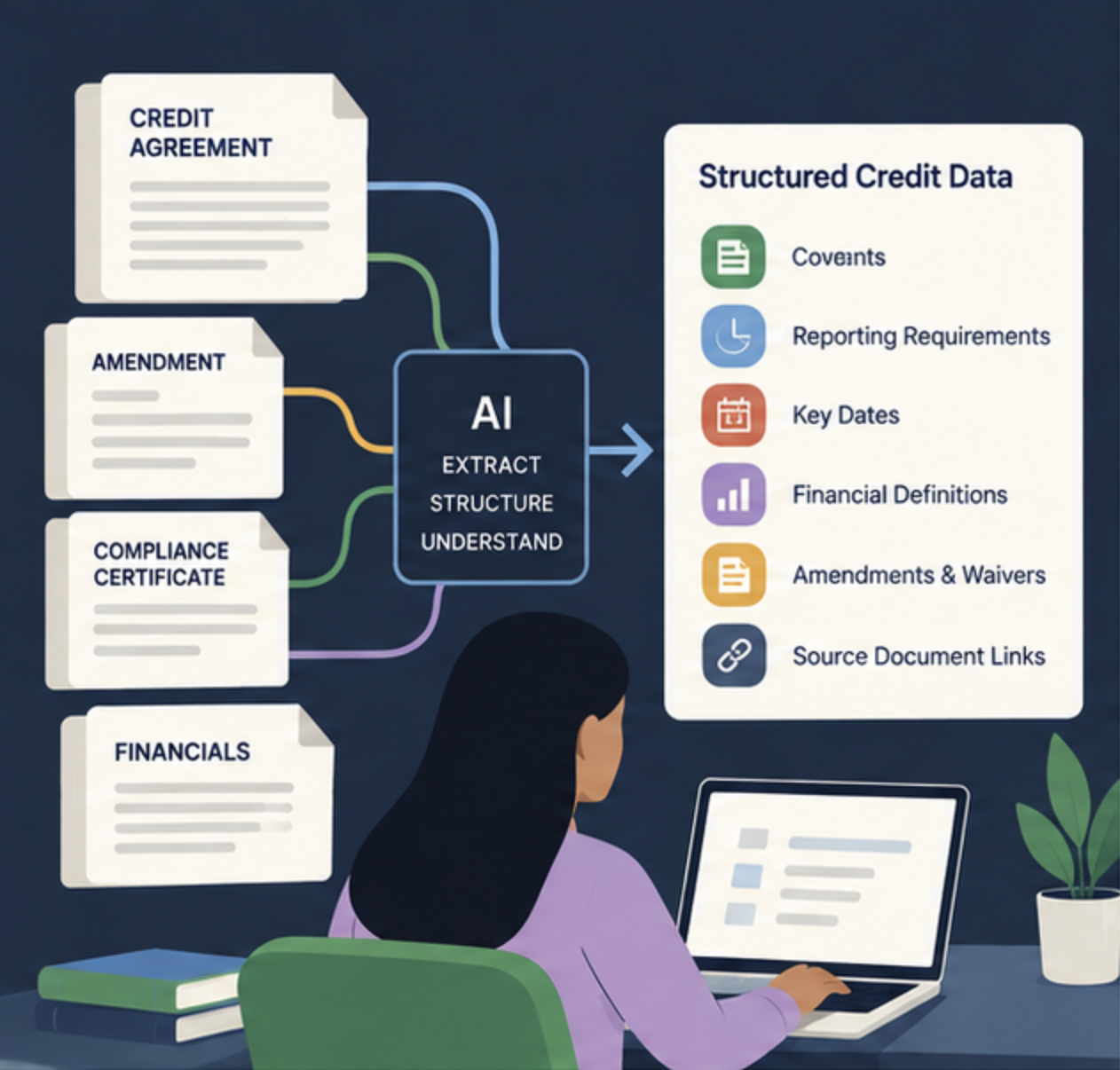
Commercial banks don’t have a shortage of data. The challenge is that some of their most important credit information isn’t really data yet. It’s language sitting inside credit agreements, amendments, compliance certificates and other documents.
*AI gives us the ability to change that. * CovenantFlow can extract this information and turn it into structured commercial credit data. We’ve built document lineage so information can be traced back to its source. We’ve built amendment and waiver tracking so the platform can understand how obligations change over time. We’ve built exception and resolution workflows that preserve what happened after an issue was identified. We’ve also built audit histories around calculations, determinations and user actions.
We originally built many of these capabilities because they make covenant monitoring better. Together, though, they do something much more interesting. They create a structured history of the credit relationship.
Instead of simply knowing that a borrower failed a leverage covenant, a bank can understand which agreement established the covenant, which definition applied, whether an amendment changed it, what borrower financial information was available, how the calculation was performed, when the exception was identified, what action was taken and how it was eventually resolved.
This isn’t just theoretical regulatory housekeeping. Federal Reserve guidance for commercial real estate lending, for example, says institutions should document exceptions, obtain appropriate approvals, report the number, nature, justification and trends of exceptions, and monitor those exceptions regularly.
That makes the history surrounding a credit valuable not only to the people managing the loan, but also to Credit Administration, Risk, Internal Audit and Regulatory Reporting.
Regulatory Reporting Starts Upstream
One of the things we’ve learned from banks is that regulatory reporting isn’t just a reporting problem. It’s also a data problem.
A bank can only report on information consistently if the underlying information has been captured, structured and governed consistently. If important credit terms remain buried in PDFs, calculations live in individual spreadsheets, exceptions are tracked through email, and amendments aren’t consistently reflected across systems, creating a reliable portfolio-level view becomes much harder.
You can see the scale of the underlying data challenge in something like the Federal Reserve’s FR Y-14Q Wholesale Risk schedules. The Corporate Loan Data Schedule collects loan-level information about both the loan and obligor as well as financial information related to the entity that is the primary source of repayment. The Federal Reserve continues to issue detailed interpretations about how individual fields should be reported, including matters such as industry classifications, financial statement information, commitments, interest rates and loan characteristics.
CovenantFlow isn’t intended to replace a bank’s regulatory reporting infrastructure. What we have been building is potentially more useful upstream: a commercial credit data and intelligence layer that can make those downstream systems richer.
We’ve already built solutions that help institutions organize commercial credit information into a consistent data layer, reconcile information against other bank systems, preserve the lineage behind important data points, and maintain historical views of how a credit and its obligations have changed.
What Did We Know at That Point in Time?
This is one of the areas I find most interesting.
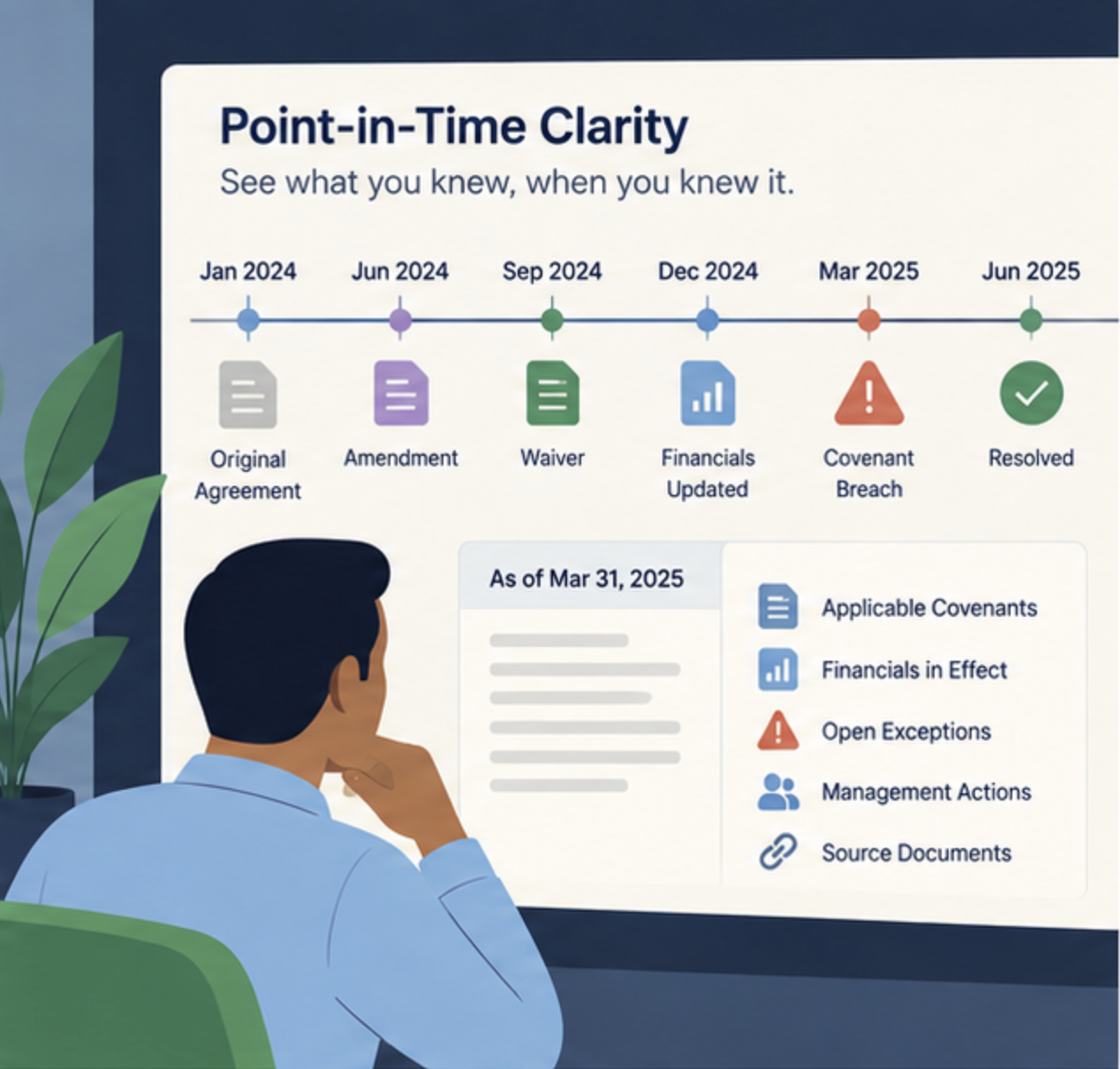
There is a big difference between asking what a loan looks like today and asking what the bank knew about that loan at the end of a previous reporting period.
A covenant may have been amended. A waiver may have been granted. New borrower financials may have arrived. An exception may have been resolved. The current state doesn’t necessarily tell you what the state was three, six or twelve months ago.
Imagine being asked why a particular borrower or exposure was represented a certain way at the end of a quarter. Answering that question shouldn’t require reconstructing the history from old spreadsheets, emails and document folders.
We have built CovenantFlow around the idea that the history matters. The platform can preserve the agreements and amendments that were in effect, borrower reporting and financial information, applicable covenants, calculations, exceptions, waivers and the actions taken around them. Just as importantly, key information can be connected back to its source.
This concept of point-in-time information becomes especially relevant when you consider regulatory reporting. FR Y-14Q, for example, requires detailed wholesale credit information based on a defined report date, including loan-level corporate and commercial real estate information.
That has led us to spend a lot of time on data lineage, evidence, calculation history, reconciliation and historical state. CovenantFlow needs to answer not only, “What is the status of this loan?” but also, “How did we arrive at this answer, and what information supported it?”
From Individual Loans to Portfolio Risk
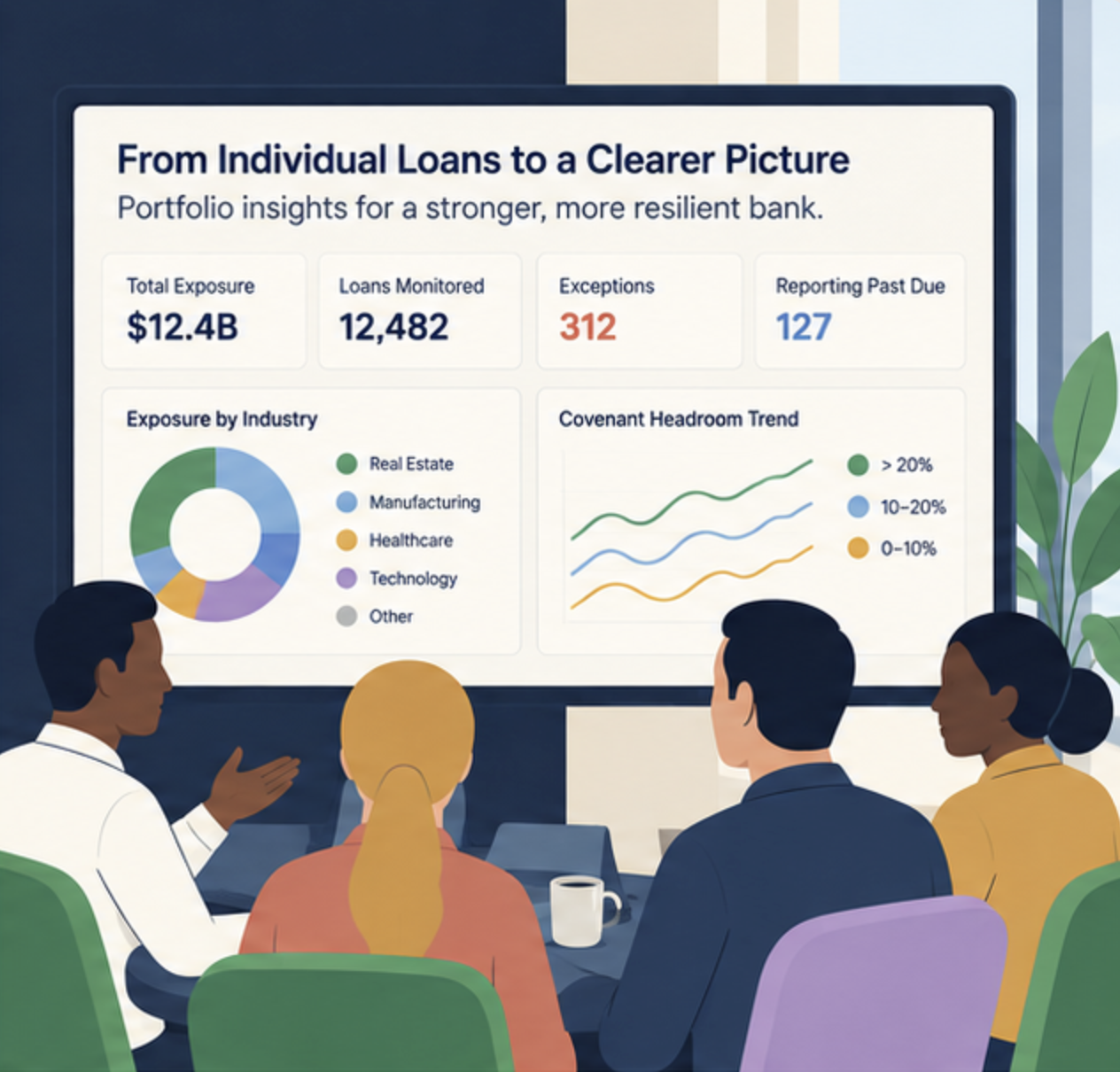
The opportunity gets even more interesting when this information is structured across thousands of commercial loans.
A Risk or Credit Administration team can start looking across the portfolio to understand how much exposure is associated with unresolved covenant exceptions, where covenant headroom is deteriorating, which borrowers are repeatedly late with required reporting, where waivers are becoming more common, or whether certain industries or segments are beginning to show increased stress.
This portfolio view isn’t simply a nice-to-have management dashboard. Current OCC supervisory material explicitly discusses using ongoing supervision to identify changes, trends, concerns and emerging risks. Federal Reserve real estate lending guidance also calls for management to monitor the loan portfolio and provide timely and adequate reporting to the board.
We’ve built portfolio-level capabilities around this idea. Covenant information, borrower reporting, exceptions and resolution history don’t have to remain isolated within individual loan files. They can become part of a broader risk intelligence layer.
That also creates an opportunity to identify early warning signals that aren’t obvious when each loan is reviewed independently. A single late financial statement may not mean much. Repeated late reporting combined with declining covenant headroom, deteriorating financial performance, multiple waivers and unresolved exceptions can tell a very different story.
AI makes it possible to extract and organize this information at a scale that wasn’t practical before. Once structured, the information can be useful for far more than covenant monitoring.
Building for Risk, Audit and Regulatory Teams
As we’ve expanded CovenantFlow, we’ve thought about how different groups inside a bank need to interact with the same underlying information.
A relationship manager may want to know which borrower financials are due next week. Credit Administration may want to see every unresolved exception and how long it has been outstanding. Risk may want to understand the exposure associated with borrowers showing covenant deterioration. Internal Audit may want the history behind a particular determination. A regulatory reporting team may need structured credit information that can be reconciled against other systems and ultimately used within the bank’s existing reporting infrastructure.
These are different use cases, but much of the underlying data is the same.
That’s an important part of our thesis. CovenantFlow doesn’t have to replace every system a bank already uses. We can become the commercial credit intelligence layer that makes those systems richer.
Loan documents, amendments, borrower financials and existing bank systems feed that layer. CovenantFlow structures obligations, calculations, exceptions, history and evidence. That information can then support covenant monitoring, portfolio risk, audit, regulatory reporting and other downstream applications.
AI Is Only Part of the Answer
Building this for banks has reinforced something John and I have believed from the beginning. In a regulated environment, getting an answer from AI isn’t enough.
The institution needs to know where the answer came from.
If CovenantFlow identifies a covenant, a user should be able to trace it back to the source document. If an amendment changed that covenant, the system needs to preserve that history. If a calculation determines that a borrower is out of compliance, the calculation needs to be reproducible. If a human reviews, overrides or resolves an issue, that activity needs to become part of the record.
The regulatory guidance supports this emphasis. Federal Reserve credit risk review guidance specifically calls attention to documentation, approvals, automated underwriting and scoring overrides, covenant adherence and internal risk-rating processes. Separate guidance on commercial real estate workouts emphasizes updated financial information, risk-rating frameworks, proper tracking, management approvals, credit review, and timely and accurate reporting.
This is why we’ve spent so much time on data lineage, deterministic calculations, human review, version history, reconciliation and auditability. They may not be the AI features that generate the most headlines, but for banks they’re some of the most important parts of the product.
The Opportunity Our Customers Helped Us See
John and I still believe covenant monitoring is a great entry point. It’s an important process that remains surprisingly manual at many financial institutions, and AI can make it dramatically better.
But our customers helped us see that the infrastructure required to monitor covenants across thousands of loans creates something much more valuable along the way.
Every agreement we structure creates commercial credit data that previously wasn’t readily usable. Every calculation creates another observation about borrower performance. Every reporting requirement creates another signal about the relationship. Every amendment, exception, waiver and resolution adds to the historical record. And every connection back to the source creates evidence that helps explain why the bank reached a particular conclusion.
We’ve taken those lessons and built them into CovenantFlow.
What started as a platform for extracting and monitoring commercial loan covenants is becoming a much broader commercial credit intelligence layer, one designed to support the people managing individual loans as well as the Risk, Audit and Regulatory Reporting teams responsible for understanding the portfolio as a whole.
We didn’t fully appreciate that opportunity on day one. Our customers helped us see it. John and I listened, and we’ve been building for it ever since.